Six solutions to spearhead airport sustainability

Breaking down the complexity of airport sustainability
Airport sustainability involves balancing various factors. Airports need to consider their environmental impact, passenger and employee needs, and economic viability. At NACO we understand that these interrelated factors make airport sustainability complex. In this article, we break it down into 3 categories: sustainable buildings, sustainable ground infrastructure and sustainable flight.
Get clarity and inspiration and explore six of the game-changing solutions that could transform the face of aviation – and your airport – in the coming decades.
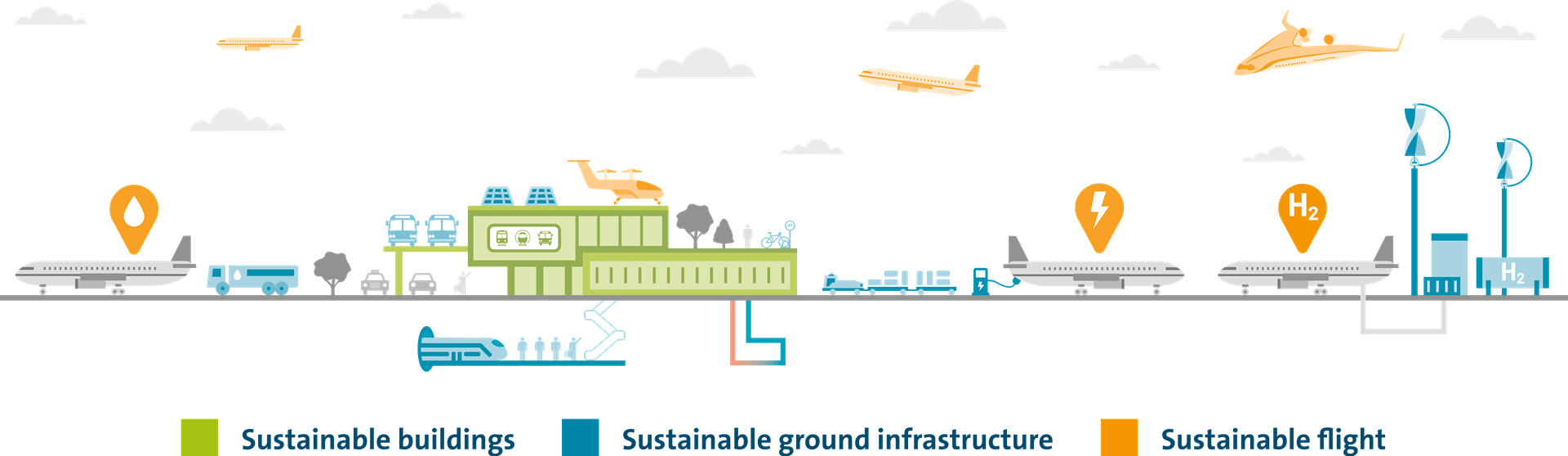
Sustainable buildings
How to build with airport sustainability at heart?
-
Circular buildings and materials
A circular building incorporates numerous design features and initiatives to promote resource efficiency, both internal and external to the airport building.
Internally circular practices for airports could include low/no carbon materials, waste separation, use of local goods, on-site renewable energy production, and triple-glazed windows. Externally, circular practices at airports may involve noise reduction, material reuse, stormwater reuse, and biodiversity protection.
The external and internal initiatives culminate in a future-proof design that focuses on sustainability and circularity in both the building structure and its operation.
Recycled materials pose a particularly attractive solution for airport sustainability: combining both circularity and cost-effectiveness. Choosing recycled materials during runway repair and replacement is a great opportunity for airports to reduce costs and promote a circular economy. In practice the old pavement materials can be recycled into base and subbase material through readily available techniques and equipment.
-
Onsite Renewable Energy
Due to their unique features, airports consume large amounts of natural resources – namely electricity and fuel. Where global primary energy consumption has grown 50%, global renewable energy stands at 11% of the total energy mix. To meet their sustainability goals, airports can employ various onsite renewable energies which are sustainable – and will serve to drive down both costs and energy consumption in the long term.
Large roof areas of airports make solar an attractive option to harness those solar arrays. At NACO, we assist our clients in their renewable energy strategy, renewables design integration, and implementation into their airports.
Traditional horizontal wind turbines have blades that create turbulent air behind them, which can lead to air safety issues for low-flying aircraft such as helicopters and soon-to-fly UAM vehicles. Vertical Axis Wind Turbines (VAWT) eliminate issues with wind turbulence while having a smaller land use requirement due to the blades being vertical and thin.
Finally, geothermal energy, capable of both heating and cooling airport buildings, is emerging as a promising renewable energy for airports looking to make the energy they consume more sustainable. As this energy system is primarily underground, it’s ideal for airports with minimal space to allocate.
Sustainable ground infrastructure
How can airside emission reduction contribute to airport sustainability?
-
Airside Vehicle Sustainability
Electrification has been the dominant energy method for smaller passenger vehicles and GSE in the path towards airside decarbonisation. This energy source has particularly excelled on airside with small baggage tugs which are required to operate in confined baggage handling make-up areas where exhaust fumes being avoided is vital. This success has translated to electrification coming to more GSE such as belt loaders, ground power units but struggling to translate to larger vehicles such as refuel bowsers, ULD Transporters and wide-body pushback tractors. Electrification has a key limitation in its range and battery capacity, which is where hydrogen GSE becomes an attractive option due to its fast refuelling times and larger range capacities.
-
Intermodal transportation
NACO and Royal HaskoningDHV we can assist airports to design world-class multimodal sustainable transport hubs to improve connectivity and access to different modes of transport. From high-speed rail and public transport to parking facilities and tour buses, we create the next generation of airports that functions as multimodal transport hub.
Sustainable flight
What flight innovations will advance airport sustainability?
-
New aircraft designs
Urban Air Mobility (UAM) innovations promise low maintenance costs and zero emissions with quiet operations possible from both airports and dedicated “vertiports”. Developments in this space have been growing year on year, with traditional aircraft manufacturers, start-up manufacturers, airlines, and aircraft leasing companies all getting involved in this quickly evolving sector. When these aircraft go from concept to real-life, airports need to prepare their infrastructure to accommodate them, whatever their needs may be.
-
Fuel innovations
Firstly, Sustainable Aviation Fuel (SAF) is a “drop-in” fuel that allows for a substantial decrease in aircraft emissions with little change to existing infrastructure. SAF is produced from sustainable sources such as biomass (ex. algae) and waste feedstocks (ex. food waste, municipal and agricultural waste) and is refined at dedicated SAF refineries. These refineries can then transport SAF via direct pipelines to airports, further reducing the overall emissions impact of the fuel.
Recently, lithium-ion battery-electric aircraft have been gaining momentum. Key airlines and airports are already looking to deploy and accommodate the aircraft respectively. Current electric plane in development is a 9 to 19-seater , capable of short flights, due to energy density constraints with lithium-ion batteries. Through research and collaboration between key stakeholders, the electric battery aircraft is evolving to become a commercial proposition.
Finally, hydrogen usage in aircraft has seen a major boost. Both traditional aircraft manufacturers and start-ups are designing and aiming to implement hydrogen propelled aircraft into service as soon as 2025. The challenge, however, is the “non-drop in” nature of this fuel. This will require effective collaboration between airports and airlines to ensure that the necessary infrastructure is available when the aircraft is put in service.
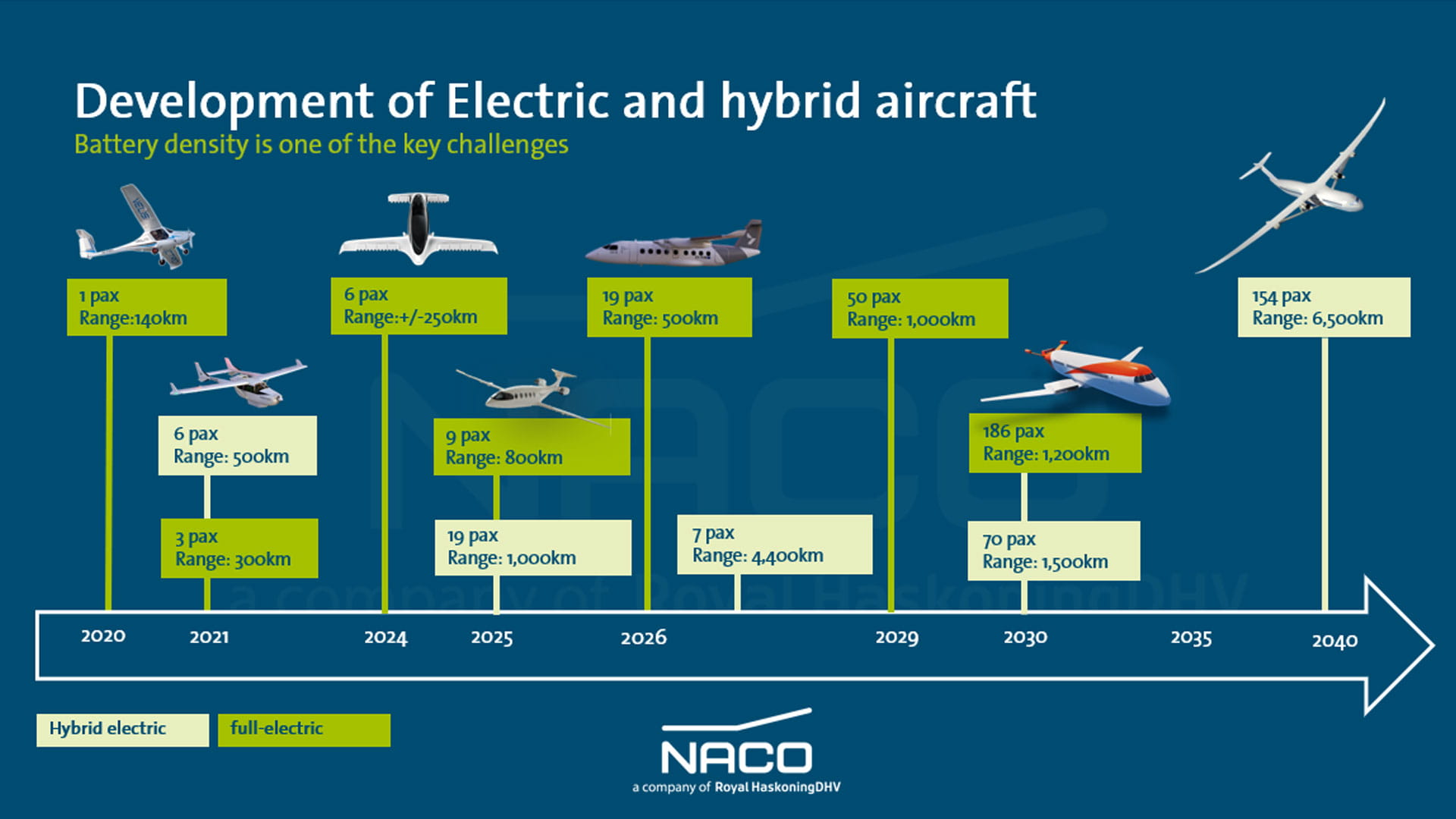
Finally, hydrogen usage in aircraft has seen a major boost. Both traditional aircraft manufacturers and start-ups are designing and aiming to implement hydrogen propelled aircraft into service as soon as 2025. The challenge, however, is the “non-drop in” nature of this fuel. This will require effective collaboration between airports and airlines to ensure that the necessary infrastructure is available when the aircraft is put in service.
Airport sustainability solutions that meet your needs, at each step of the transition
At NACO, we know that developing a sustainable airport is not an overnight project. It requires vision and commitment. Any strategy at its heart must be tailored to your airport’s unique needs, ambitions and limitations. From that foundation, progress is driven by collaboration between key stakeholders to realise a sustainable airport transition.As an airport you need an integrated approach to sustainable airport strategy. And this is exactly what we do. We accelerate your sustainability transition using decades of experience at the forefront of the aviation industry. If you’re looking for a partner to realize your vision, or an expert opinion on your plans in progress, get in touch with us today.